Gamma Exposure and 0DTE Pins: Why One Number Misreads the Day
One gamma exposure number hides the day. The gamma flip, positive vs negative gamma, pins vs max pain, and why 0DTE gamma sharpens into the close.
Key takeaways
- Gamma exposure (GEX) at the current price is one number. A 0DTE session travels across many prices, so what matters is the shape of dealer gamma along price: where it peaks, where it dips and where it changes sign.
- Positive gamma means dealers (market makers) hedge against the move. Negative gamma means they hedge with it. The gamma flip is the price where one turns into the other.
- A peak in dealer gamma is a pin: the stickiest price nearby. A dip is a soft spot: the price nearby where hedging resists least, or adds the most.
- 0DTE gamma sharpens through the day even if nothing trades. A strike's hedging spreads about 30 points either side with 6 hours left and about 7 points with 20 minutes left, so pins multiply into the close.
- Two sets of positions can carry exactly the same gamma exposure at spot and mean opposite days: one sits on a pin, the other on a soft spot between two pins.
- A pin is not max pain. Max pain is read from open interest alone and gives one strike for the whole day; a pin comes from the dealers' hedging and moves with the clock.
Why one gamma exposure number is not enough
The most common summary of options positioning is a single figure: dealers are long or short so many dollars of gamma exposure at the current price. The figure is real, but it describes one price, and a 0DTE session travels across many.
Suppose dealer gamma at 6,000 is large and positive. If it stays large for 50 points in both directions, the session should feel heavy everywhere near the market. If it falls away 15 points higher and turns negative 15 points lower, a 15-point move changes the character of the tape completely. The headline number cannot tell those two days apart. The shape of the gamma profile, dealer gamma drawn across price, can.
Positive gamma, negative gamma and the gamma flip
Gamma is the rate at which an option's delta changes as the index moves. For a dealer it measures how much must be bought or sold, for each point the index moves, to stay hedged. The charts below show it on relative scales.
- Positive gamma. The dealers are net long options. To stay hedged they sell into rallies and buy into dips, leaning against the move.
- Negative gamma. The dealers are net short options. They buy into rallies and sell into dips, hedging with the move and adding to it.
- The gamma flip. The price where the dealers' net gamma changes sign, also called the zero gamma level. On the positive side the hedging dampens moves; on the negative side it amplifies them.
These three ideas describe the sign of dealer gamma. They say nothing about how strong it is a few points away, and that is where the session is decided.
0DTE gamma, hour by hour
The time left to expiry decides how tall and how wide each strike's gamma is. Gamma at the strike grows with one over the square root of the time left; the region it covers shrinks with the square root of the time left.
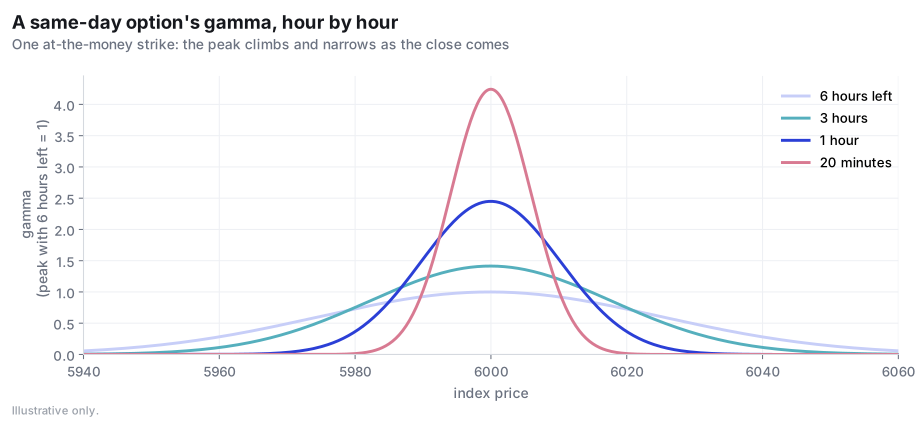
With 6 hours left, an at-the-money option's hedging stays above half its peak within about 29 points of the strike. With 1 hour left, the peak is about 2.4 times as tall and that band is about 12 points wide on each side. With 20 minutes left, the peak is about 4.2 times as tall and the band about 7 points.
In the morning each strike's hedging is spread across a wide region and neighbouring strikes blur together. Into the close, each strike's hedging is packed into a few points around it. That single fact explains most of how a 0DTE gamma map behaves through the day.
Reading a gamma map: pins, soft spots and the gamma flip
Take a made-up book around an index at 6,000. The dealers are short options at 5,925, 5,950 and 5,975, long at 6,000, short a smaller block at 6,025, and long again at 6,040, 6,050 and 6,075.
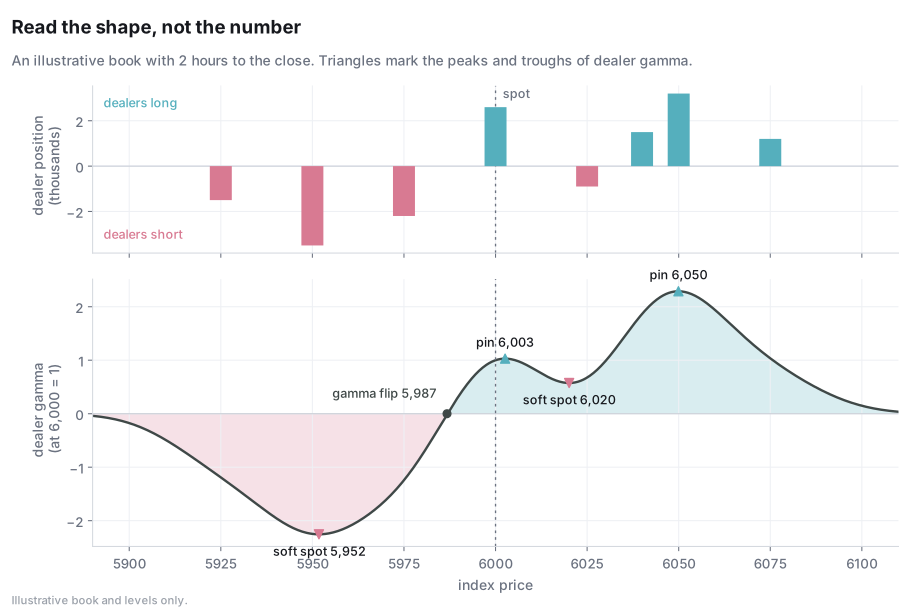
With 2 hours to the close the profile reads like this:
- At 6,000 the dealers have positive gamma, and it rises a little toward 6,003. The price sits on a pin, where moves away meet the most resistance nearby.
- At 6,020 gamma dips to a little over half its level at 6,000 before rising again. This is a soft spot. Gamma is still positive there, so hedging does not add to a move, but it resists least within this stretch. A rally that gets through it meets rising gamma toward the next pin.
- At 6,050 gamma peaks at about 2.3 times its level at 6,000: the strongest pin on the map, where the dealers' long calls are concentrated.
- At 5,987 is the gamma flip. Below it dealer gamma turns negative and reaches its deepest at 5,952, about as large as the 6,050 peak but on the other side: a soft spot where the hedging sells into a decline and buys into a bounce.
The book's gamma exposure at spot is a modest positive number. The profile says much more: the tape near 6,000 should be sticky, the upside has one soft spot before a strong pin, and the downside changes character 13 points lower.
The same book, four times of day
Hold the book fixed and let only the clock run.
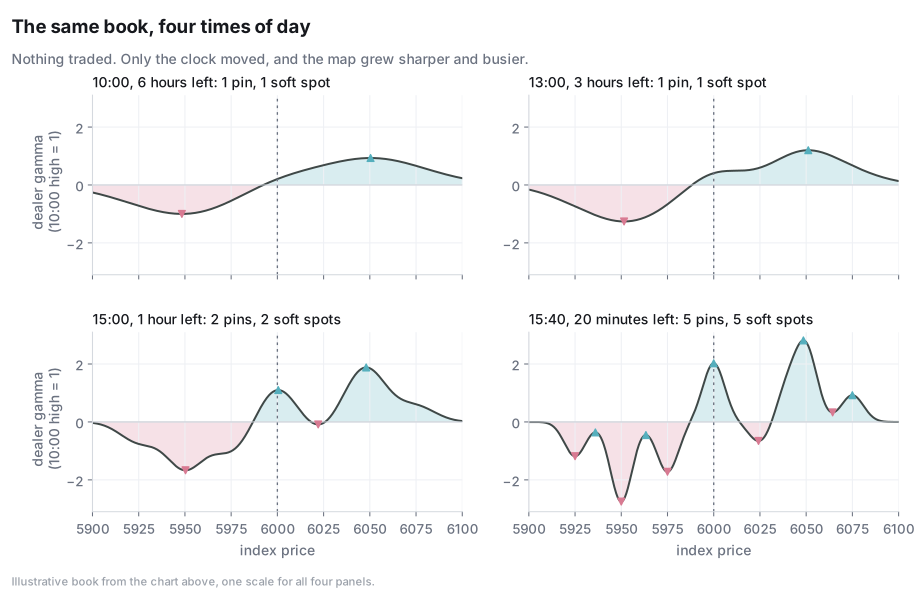
At 10:00 the strikes blur into two broad regions, negative gamma below about 5,992 and positive above, with one pin near 6,050 and one soft spot near 5,948. By 13:00 the 6,000 block shows as a shoulder but not yet as its own peak. By 15:00 it has become a pin, and a soft spot has opened at 6,022 between it and the calls above. By 15:40 every cluster of strikes has its own peak or trough: five pins and five soft spots within 150 points, and the map is almost three times taller than at 10:00.
Two practical points follow. A level that is a pin in the afternoon may be no level at all in the morning, because its strike's hedging has not yet separated from its neighbours'. And late in the day the map turns local: a pin 40 points away matters far less with 20 minutes left than it did at noon.
Same gamma exposure, two opposite days
The clearest way to see why the shape matters is to build two books with the same gamma exposure at spot.
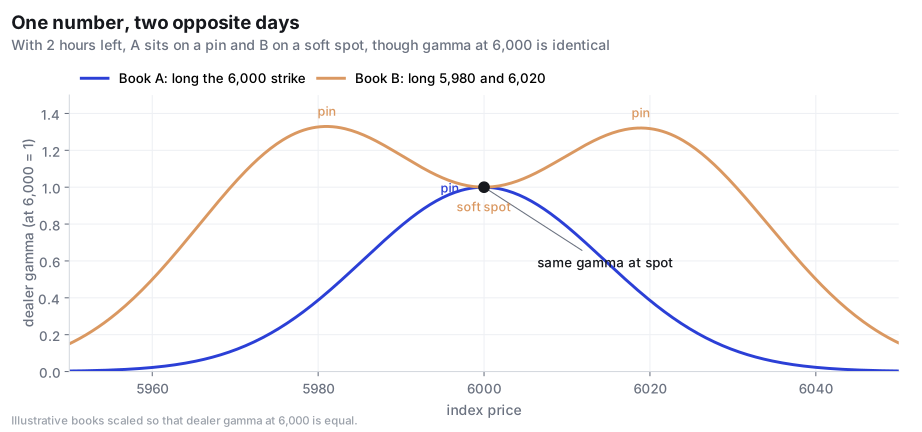
Book A holds one block at 6,000. Book B holds two blocks, at 5,980 and 6,020, scaled so that its gamma at 6,000 matches A's exactly. A one-number GEX summary calls these the same day.
They are opposite days. In book A the price sits on a pin: every move away from 6,000 meets less hedging, so the stickiest place nearby is right here. In book B the price sits on a soft spot: the tape should drift easily between the two pins and slow as it reaches one of them. What tells the two apart is whether 6,000 is a peak or a dip, and only the map on either side shows that.
Three questions to ask of any gamma map
A gamma exposure number answers none of these. The shape of the map answers all three.
- Am I on a peak, in a trough or on a slope? On a peak, every move away meets more resistance than here, and the tape tends to come back. In a trough, the tape moves most easily right here and slows as it reaches the peaks on either side. On a slope, one direction is easier than the other: toward the softer side.
- How far are the nearest pin and the nearest soft spot, in today's typical move? Ten points to a pin is close on a 25-point day and noise on a 60-point one. A level means something only against the size of the day.
- How much time is left? A pin 40 points away shapes the morning and is out of reach at 15:40, when each strike's hedging covers only a few points. In the morning, read the broad regions; in the last hour, read only the nearest peak and trough.
Is a pin the same as max pain?
No. They are often mentioned together, but they come from different questions.
| Max pain | A gamma pin | |
|---|---|---|
| Question it answers | Where would the options outstanding be worth the least at expiry? | Where does dealer hedging lean hardest against a move? |
| What it is about | Money: what the options pay out at the close | Behaviour: how the tape should trade near a level |
| Who it concerns | The option holders as a group | The dealers who have to hedge |
| How many | One strike for the day | One or several, depending on the book and the hour |
| Through the day | Fixed | Moves and sharpens as expiry nears |
Max pain is the strike where option holders, in total, would collect the least. The theory behind it says the market drifts there; the hedging story behind a pin gives a reason it might. Price clustering at strikes on expiration days has been documented for individual stocks and linked to the delta hedging of options positions (Ni, Pearson and Poteshman, 2005). The two levels can coincide, when the largest open interest sits where the dealers are long gamma, but they need not.
Pin risk at the close
Pin risk is the risk of holding an option at expiry while the close lands at, or very near, its strike. For physically settled, American-style options such as SPY, the classic pin risk is not knowing whether a short option will be assigned, and waking up with an unwanted share position. SPX same-day options are European-style and cash-settled on the closing print, so that assignment uncertainty does not arise. What remains is the payoff risk: near the strike in the final minutes, gamma is so concentrated that a few points decide whether the option pays nothing or something, and the position's value swings with every tick.
What no gamma map can tell you
- Positions are never fully visible. No public data shows exactly who holds what, so every gamma map is an estimate, and its quality decides whether a level is real.
- Same-day positions change during the session. Much 0DTE volume opens and closes within the day. A map drawn before the open describes the positions as they stood, not as they will be at 15:00.
- Volatility moves the profile. When implied vol rises, each strike's gamma spreads wider and lower, and the peaks soften. A pin is strongest on a quiet day.
- Hedging is one flow among many. A pin is where hedging leans hardest against a move, not a barrier the index cannot cross. News and larger orders can carry the index through any level.
- The reading is comparative. A pin is stickier than the prices around it, and a soft spot softer. The map does not say how fast the tape will move in absolute terms.
How morphic approaches it
Before each session morphic publishes one map of the day ahead: the levels that matter, and the odds the options market prices for reaching each one. morphic provides market-structure commentary, not trade calls or investment advice.
Frequently asked questions
What is gamma exposure (GEX)?
Gamma exposure is an estimate of how much the options dealers must buy or sell to stay hedged as the index moves. Positive means they hedge against moves; negative means they hedge with them.
What is the gamma flip?
The gamma flip, or zero gamma level, is the price where the dealers' net gamma changes sign. On one side their hedging dampens moves; on the other it adds to them.
What is the difference between positive gamma and negative gamma?
With positive gamma, dealers are net long options and hedge by selling rallies and buying dips. With negative gamma they are net short options and hedge by buying rallies and selling dips. Positive gamma tends to calm the tape, negative gamma to stretch it.
What is a gamma pin in SPX?
A pin is a price where dealer gamma reaches a local peak. It is the stickiest price nearby, where hedging leans hardest against a move, and it matters most in the last hours of a 0DTE session.
What is the difference between a pin and max pain?
Max pain is the one strike where the open options would be worth the least at expiry, read from open interest alone. A pin describes the dealers' hedging: it shifts and sharpens as the session runs, and there can be several in one day.
How do market makers hedge 0DTE options?
Mostly by trading the underlying exposure, often in ES futures, so that their net delta stays near zero. How much they trade for each point depends on their gamma, which for same-day options grows sharply as the close approaches.
Why does 0DTE gamma get stronger into the close?
An option's gamma at its strike grows with one over the square root of the time left. With 20 minutes left, an at-the-money same-day option carries about four times the gamma it had with 6 hours left, packed into a band about a quarter as wide.
Does pin risk apply to SPX options?
The assignment kind does not: SPX options are European-style and cash-settled. The payoff kind does: when the close lands near a strike, a few points decide the payoff, and the value of a position held there swings with every tick in the final minutes.
Sources and further reading
- Haug, E. G. (2007), The Complete Guide to Option Pricing Formulas, 2nd edition, McGraw-Hill: the option greeks
- Taleb, N. N. (1997), Dynamic Hedging: Managing Vanilla and Exotic Options, Wiley: how option dealers hedge
- Ni, S. X., Pearson, N. D. and Poteshman, A. M. (2005), Stock price clustering on option expiration dates, Journal of Financial Economics
This article is educational and describes general market concepts. It is not investment advice or a recommendation to buy or sell any security or contract. Options and futures trading, including 0DTE trading, carries a substantial risk of loss. All books, levels and figures are made up for illustration.
More from the blog
Anchored VWAP and Liquidity: How to Read Where SPX and ES Agreed on Value
Learn how anchored VWAP (AVWAP) maps liquidity on ES and SPX: formulas, anchor selection, volatility, four readings and what options add.
 Dor S.Oct 20, 2026 · 13 min read
Probability of Touch vs Probability of Expiring In the Money: What SPX 0DTE Traders Get Wrong
Probability of touch is about 2x the odds of finishing in the money. The math, SPX 0DTE tables, the skew catch, and stops and targets.
Ofri B.Oct 20, 2026 · 13 min read